Silk Weavers of Hill Tribe Laos: Textiles, Tradition, and Well-Being by Joshua Hirschstein & Maren Beck
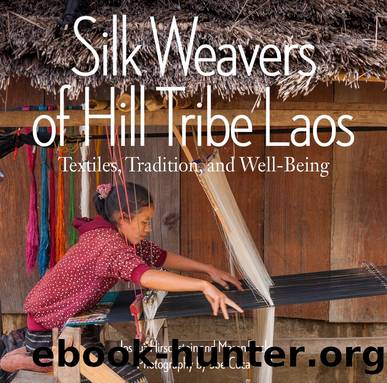
Author:Joshua Hirschstein & Maren Beck [Hirschstein, Joshua & Beck, Maren]
Language: eng
Format: epub
ISBN: 9780997216899
Google: 6u2pAQAACAAJ
Published: 2017-09-15T02:54:47.651114+00:00
Phout, Souksakone, and Malaithong celebrate at Phoutâs son Jaiâs wedding.
Unlike many others in the region, Phoutâs mother remained (and still remains) devoted to dyeing her silk and cotton textiles with traditional, natural dyes. Phout remembers experimenting with the cheap chemical dyes that were imported from Vietnam, and how her mother and she hated, in particular, the dye that turned her hands a putrid, glowing green for a week. Plus, Phout adds, chemical dyes can be used only once, whereas her natural dyes can be saved and reused many times.
Phout met her husband, Bounphan, at the loom. He was a soldier, and he would visit her when she sat at her loom so they could âflirt the hours away.â They married in 1988 and became the parents of two daughters and a son (as is often the case, one child, the son, is not Phoutâs birth-child, but rather a nephew she raised from childhood). The eldest daughter, Phouang, is an avid weaver and helps run the silk business from her home in the capital, Vientiane. She and her husband, Nan (who has learned English), have also become good friends of ours. They have built a new house and bought a car, and have treated Phout to her first grandchild. Phoutâs second son, Deng, is just now completing his studies at the university in Vientiane, and we all celebrated together at the wedding of her older son, Jai, in Xam Tai in March, 2016. [We are deeply saddened to add that Bounphan, Phoutâs husband of twenty-eight years, passed away from cancer in June, 2016.]
In 2003, Phout, following the lead of her colleagues Souksakone and Lun, stepped into the business world and began dyeing silk and designing traditional textiles for the broader marketplace. On a shoestring budget and completely self-supporting, and with the inspiration of her spirited aunt Sukkhavit, Phout invested in local silk- and dye-work, committed to several of her template designs, and coordinated with several of the best local weavers to produce silks that she believed would be attractive in the developing tourist and international marketplace.
Phout is a workhorse, and is busy dawn to dusk, and even later, with any number of projects. She seems tireless, always ready to do the extra shift, whether itâs staying up until dawn to get some skeins dyed to meet our travel deadline or washing dishes after an eveningâs celebration. She brings her contagious, upbeat energy and quick, ready laugh to every task.
Her dye-work is superb, although she admittedly bows to the breadth of knowledge that Souksakone maintains. Phoutâs jewel-tone purples and blues are particularly lush and delicious, and her rich browns and greens radiate warmth and depth.
She has collected, revised, and created an array of design templates, and her expertise in template design provides the foundation for our description of the khao nyeung, the design-template attached to the loom that both dictates and preserves the complex weaving design (pages 169â179). While Phout has several treasured traditional templates (such as her man-woman phaa sabai), she
Download
This site does not store any files on its server. We only index and link to content provided by other sites. Please contact the content providers to delete copyright contents if any and email us, we'll remove relevant links or contents immediately.
The Vikings: Conquering England, France, and Ireland by Wernick Robert(82814)
Ali Pasha, Lion of Ioannina by Eugenia Russell & Eugenia Russell(40239)
The Conquerors (The Winning of America Series Book 3) by Eckert Allan W(37380)
The Vikings: Discoverers of a New World by Wernick Robert(36974)
Cecilia; Or, Memoirs of an Heiress — Volume 1 by Fanny Burney(32544)
Cecilia; Or, Memoirs of an Heiress — Volume 2 by Fanny Burney(31942)
Cecilia; Or, Memoirs of an Heiress — Volume 3 by Fanny Burney(31928)
Empire of the Sikhs by Patwant Singh(23070)
The Secret History by Donna Tartt(19046)
Hans Sturm: A Soldier's Odyssey on the Eastern Front by Gordon Williamson(18570)
Cat's cradle by Kurt Vonnegut(15333)
Pimp by Iceberg Slim(14481)
Sapiens: A Brief History of Humankind by Yuval Noah Harari(14363)
Talking to Strangers by Malcolm Gladwell(13345)
Norse Mythology by Gaiman Neil(13344)
Leonardo da Vinci by Walter Isaacson(13315)
4 3 2 1: A Novel by Paul Auster(12371)
Underground: A Human History of the Worlds Beneath Our Feet by Will Hunt(12085)
The Radium Girls by Kate Moore(12014)
